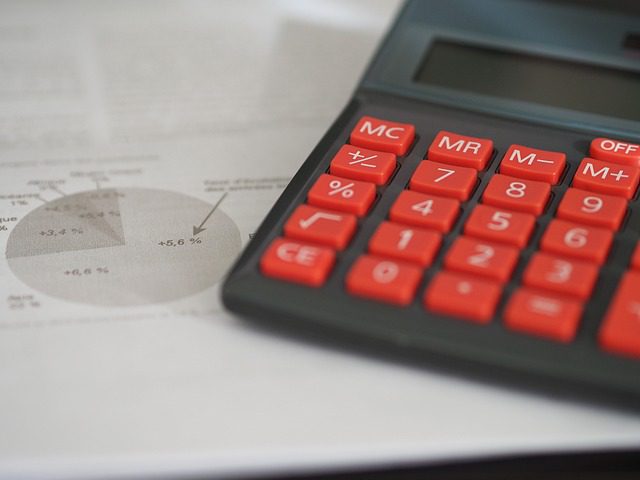
Everyday math rarely needs a spreadsheet or a scientific calculator — most of it is addition, subtraction, multiplication, and division. The trick is knowing which of the four operations to reach for in each situation, and doing it fast enough that you actually use it instead of guessing. Here are ten real situations where a basic calculator saves money, time, or both.
Use the free Basic Math Calculator for any of these — it works in the browser, so there is nothing to install.
10 Everyday Uses for a Basic Calculator
1. Grocery Shopping: Unit Price Comparison
When two sizes of the same product sit side by side, divide the price by the quantity to find the better deal. A 24 oz jar at $5.49 is $0.229/oz; an 18 oz jar at $4.29 is $0.238/oz — the big jar wins despite the higher sticker price. Over a month of groceries, these comparisons add up to real savings.
2. Splitting Restaurant Bills
A $94 bill for 4 people is $23.50 each before tip. If one person had an extra drink, add it after the split instead of complicating the division. For the tip itself, the percentage key handles it instantly — 20% on $94 is $18.80. See our Tip Calculator if you want the exact per-person total including tip.
3. Home Improvement: Paint and Materials
To estimate paint: multiply the wall length by the wall height for each wall, add them up, then divide by the coverage per gallon (about 350 sq ft per coat). A 12×10 ft room with 8 ft ceilings needs roughly 2 gallons for two coats. The same length × width × quantity pattern works for tile, flooring, and lumber.
4. Monthly Budget Percentages
Divide each expense by your monthly income and multiply by 100 to see the percentage. If your rent is $1,500 and you earn $5,000, housing is 30% of income — right at the commonly recommended threshold. Seeing the percentages makes it obvious which category is creeping up month to month.
5. Cooking: Scaling Recipes
If a recipe serves 4 but you need 6, multiply every ingredient by 1.5 (6 ÷ 4 = 1.5). For 2 cups of flour you need 3 cups; for 3 eggs you need 4.5, so crack five and whisk the extra half into a scramble. Scaling down works the same way: a 12-serving recipe halved means dividing every amount by 2.
6. Travel: Fuel Cost Estimation
Distance ÷ MPG × price per gallon = total fuel cost. A 300-mile trip at 25 MPG with $4.00/gallon gas costs 300 ÷ 25 × 4 = $48. Add a buffer for detours and traffic, and you have a realistic trip budget in seconds.
7. Fitness: Target Heart Rate
Target heart rate = (220 − age) × intensity percentage. For a 35-year-old working at 70% intensity: (220 − 35) × 0.70 = 130 bpm. Knowing your zone keeps workouts effective — too low and you coast, too high and you burn out early.
8. Shopping: Discount Math
Original price × (discount percentage ÷ 100) = savings. An $80 jacket at 25% off saves $20, so you pay $60. For stackable discounts, apply them one at a time — 20% off then 10% off is not 30% off. The order matters because each discount applies to the reduced price.
9. Home Energy: Appliance Costs
Wattage ÷ 1000 × hours used × electricity rate = cost. A 1500W space heater running 8 hours a day at $0.15/kWh costs 1.5 × 8 × 0.15 = $1.80 per day — about $54 a month. That single calculation often changes how people use space heaters.
10. Comparing Salaries and Hourly Rates
Divide an annual salary by 2,080 (40 hours × 52 weeks) to get the hourly equivalent: $52,000 ÷ 2,080 = $25/hour. This makes job offers comparable — a $55,000 salary with 10 extra vacation days may beat a $58,000 salary with fewer benefits once you factor in the hours.
Which Operation When? A Quick Rule of Thumb
| Situation | Operation | Formula |
|---|---|---|
| Best value between sizes | Division | Price ÷ Quantity |
| Total with tax or tip | Multiplication | Amount × (1 + rate) |
| Budget share | Division | Expense ÷ Income |
| Scaling a recipe | Multiplication | Amount × (new servings ÷ old servings) |
| Discounted price | Subtraction | Price − (Price × rate) |
The common thread: every one of these is a one- or two-step calculation. When you know which formula applies, the numbers take seconds. Keep the Basic Math Calculator open in a tab and the guesswork disappears from everyday spending decisions.
Related Articles:
 Area Converter: How to Convert Between Square Feet, Acres, and Square Meters for Any Project
 Geometry Calculator: How to Calculate Area, Perimeter, and Volume for Any Home or Design Project
 Basic Math Calculator: Everyday Uses for Budgeting, Shopping, and Home Projects
Engineering Calculator: How to Calculate Force, Work, Power, and Mechanical Advantage Online
Basic Math Calculator: Everyday Uses for Budgeting, Shopping, and Home Projects
Engineering Calculator: How to Calculate Force, Work, Power, and Mechanical Advantage Online
Leave a Reply
You must be logged in to post a comment.